Cloud
GCP vs AWS: A Quick Decision Guide for Digital Teams
5 min read
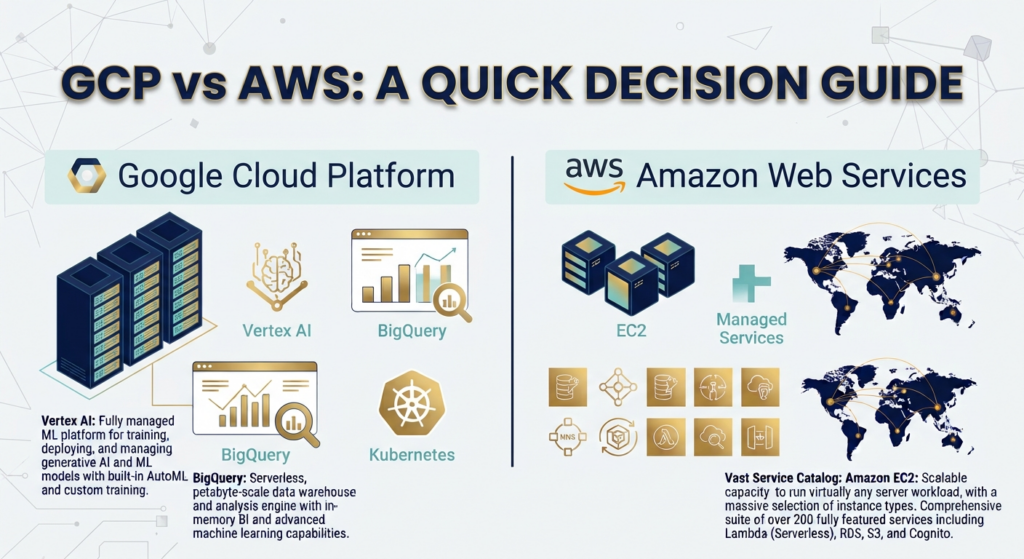
Choosing the right cloud infrastructure provider is an important strategic decision for any growing digital business. Google Cloud and Amazon Web Services (AWS) both offer extensive infrastructure, security capabilities, global coverage and tools for building and scaling digital products. However, their service ecosystems, pricing models and areas of particular strength can influence which platform is the best fit for your organisation.
Whether you’re developing a new application, modernising existing infrastructure or improving the performance of your digital services, this guide compares the key considerations when choosing between Google Cloud and AWS.
Google Cloud (GCP)
Google Cloud is particularly attractive to organisations working with large datasets, modern application architectures and integrated artificial intelligence and machine learning services.
Key advantages
- Data analytics and AI: BigQuery provides a managed analytics platform for processing and analysing large datasets, while Vertex AI supports machine learning and AI development. Integration with Google’s wider AI ecosystem can make Google Cloud a strong choice for data-driven applications.
- Managed Kubernetes and containers: Google Kubernetes Engine (GKE) offers an integrated managed Kubernetes platform with capabilities designed to simplify cluster operations, scaling and workload management. Cloud Run provides another option for deploying containerised applications without managing the underlying infrastructure directly.
- Flexible pricing options: Google Cloud offers automatic discounts on eligible resources, alongside committed use discounts for organisations able to make longer-term usage commitments. Potential savings depend on the services used and the terms of the commitment.
- Global network infrastructure: Google’s global network can support high-performance applications and communication between services. Actual latency and data transfer performance depend on workload design, geographic location and network configuration.
Strategic considerations
- Service ecosystem: Google Cloud offers a broad range of services, but AWS has a larger overall service catalogue. Organisations with specialised requirements should check the availability and maturity of specific services before committing.
- Skills and partner availability: AWS has a particularly extensive ecosystem of cloud specialists, implementation partners and third-party integrations. Google Cloud also has a substantial partner network, although local availability of relevant expertise varies.
Amazon Web Services (AWS)
AWS is an established cloud platform with an extensive range of infrastructure services, enterprise capabilities and third-party integrations. Its breadth makes it suitable for organisations building new digital products as well as those migrating complex existing systems.
Key advantages
- Broad service portfolio: AWS provides services across compute, storage, networking, databases, security, analytics, AI, Internet of Things (IoT) and edge computing. This breadth can be valuable when an organisation has diverse technical requirements.
- Established enterprise ecosystem: A large network of certified professionals, implementation partners and third-party solutions can help organisations implement, integrate and manage AWS environments.
- Flexible cost optimisation: AWS offers Savings Plans and Reserved Instances for eligible workloads. Depending on the service, purchasing option and commitment, these can reduce costs significantly compared with applicable On-Demand rates. AWS advertises savings of up to 72% for certain eligible purchasing options; actual savings vary.
- Global infrastructure: AWS operates a broad network of geographic Regions and Availability Zones, supporting a range of deployment, resilience and data residency requirements. Organisations must still select appropriate locations and configure their workloads to meet their own availability and compliance objectives.
Strategic considerations
- Pricing complexity: The range of services, usage-based charges, data transfer costs and purchasing options can make AWS expenditure difficult to forecast without effective monitoring and cost management. FinOps practices can help organisations understand usage, allocate spending and identify optimisation opportunities.
- Operational complexity: AWS offers considerable architectural flexibility, but this can introduce additional decisions around networking, identity and access management, security, monitoring and service integration. Managed services such as Elastic Kubernetes Service (EKS) can reduce operational effort, although the level of management required depends on the implementation.
Google Cloud vs AWS: Quick comparison
| Feature | Google Cloud (GCP) | Amazon Web Services (AWS) |
|---|---|---|
| Core strengths | Data analytics, integrated AI and modern application platforms | Broad service portfolio, enterprise infrastructure and integrations |
| Kubernetes | GKE offers an integrated managed Kubernetes experience | EKS offers managed Kubernetes with extensive AWS integration |
| Application development | Cloud Run, GKE and integrated developer services | Extensive compute options, managed containers and application services |
| Pricing | Automatic discounts on eligible usage and committed use discounts | Savings Plans, Reserved Instances and other purchasing options |
| Data analytics | BigQuery and integrated data services | Amazon Redshift, AWS analytics services and partner integrations |
| Ecosystem | Strong data, AI and cloud-native ecosystem | Particularly broad service, partner and enterprise ecosystem |
| Best suited to | Data-intensive applications, analytics-led organisations and Google-centric workloads | Diverse enterprise workloads, complex migrations and organisations requiring a wide choice of services |
These are general characteristics, not absolute advantages. Both platforms support enterprise applications, AI workloads, analytics, containerisation and complex infrastructure.
Which cloud platform should you choose?
The best choice depends on your existing technology, workloads, in-house skills, budget and long-term objectives.
Consider Google Cloud if:
- Your organisation relies heavily on BigQuery, data engineering or integrated AI services.
- You want managed container platforms such as GKE or Cloud Run.
- Your application architecture benefits from Google’s data and application development ecosystem.
- Your technical team already has experience with Google Cloud or related technologies.
Consider AWS if:
- You need a particularly broad selection of cloud services.
- You’re migrating complex legacy applications or working with established AWS infrastructure.
- You need access to a large network of implementation partners, specialists and third-party integrations.
- Your architecture benefits from AWS-specific services or existing enterprise agreements.
Compare both platforms before committing
If cost, performance or resilience is a primary concern, compare representative workloads and include compute, storage, data transfer, monitoring, support and operational overheads. A service with a lower headline price may not deliver the lowest overall cost once the full architecture is considered.
Ultimately, the right cloud platform is the one that meets your technical requirements, supports your business objectives and can be operated securely and cost-effectively as your organisation grows.
Need help optimising your digital infrastructure?
Evisible helps businesses improve digital visibility, measurement and performance through analytics implementation, tag management and technical consultancy.
Whether you’re reviewing your analytics architecture, improving tracking reliability or assessing the performance of your digital services, we can help you identify practical opportunities for improvement.
*Need strategic guidance on optimising your web architecture, tag management, or cloud performance? Connect with the team at Evisible.*